

TWO RECENT STUDIES PROVIDE MEANINGFUL GUIDANCE ON EXERCISE IN TYPE 1 DIABETES
May 2026


Regular physical activity is a cornerstone of cardiovascular health and blood sugar management in type 1 diabetes (T1D). Despite the well-documented benefits of exercise for insulin sensitivity and weight management, fear of exercise-induced hypoglycemia remains a primary barrier to patient adherence. Two recent studies published in Diabetologia provide meaningful data on the effects of exercise on blood glucose levels.
In the first study, researchers evaluated glucose data from over 420,000 exercise sessions in 3,248 type 1 diabetics. The data found the following effects of exercise on blood sugar levels:
- Walking: average decrease of 22.34 mg/dL
- Aerobic exercise (e.g., jogging, cycling): average decrease of 25.77 mg/dL
- Anaerobic Exercise (e.g., weightlifting, interval training): average decrease of 9.37 mg/dL
- Post-exercise glucose effects: Aerobic activities presented the highest probability of inducing acute post-exercise hypoglycemia. Walking had a lower risk of nocturnal hypoglycemia than aerobic or anaerobic exercise. Contrary to previous assumptions, the study found no clinically significant difference in the risk of nocturnal hypoglycemia between exercise sessions performed early in the day versus those performed later in the afternoon or evening (after 15:30).
In the second study, researchers used data from 834 type 1 diabetics and 16,430 exercise sessions to develop a heatmap that predicts the risk of exercise-induced hypoglycemia based on the following 3 components: (1) blood glucose level immediately before exercise; (2) exercise duration; (3) glucose rate of change (trending up or down) over the 15 minutes prior to exercise. Using this information, patients can find their position on the heatmaps below to determine their risk of hypoglycemia during exercise.
Exercise-induced hypoglycemia remains a major concern and source of anxiety for people with type 1 diabetes. The findings from these two studies offer important insights to help clinicians better counsel patients and support their exercise goals.
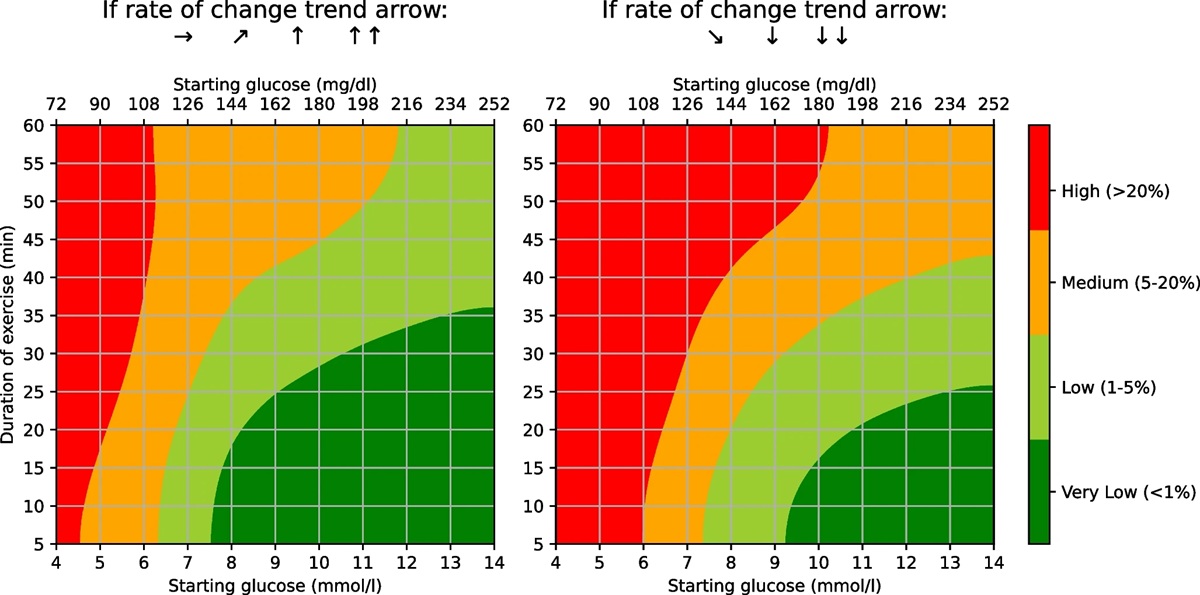
- GlucoseGo heatmap showing the predicted risk of hypoglycemia during exercise based on the simplified XGBoost model. The heatmap is divided into two panels according to glucose trend arrows: the left panel shows bouts with stable or rising glucose, and the right panel shows bouts with falling glucose. Color-coded risk categories are represented as follows: dark green (<1% risk), light green (1-5% risk), amber (5-20% risk), and red (>20% risk). This heatmap is reproduced from the study 'GlucoseGo: a simple tool to predict hypoglycemia during exercise in type 1 diabetes' by Catherine L. Russon et al. (2026), licensed under the Creative Commons Attribution 4.0 International License; no changes were made to the original material. [5]
- Exercise in type 1 diabetes: real-world data on glucose levels and hypoglycaemia risk from over 420,000 exercise sessions, Diabetologia (2026) [PubMed abstract]
- GlucoseGo: a simple tool to predict hypoglycaemia during exercise in type 1 diabetes, Diabetologia (2026) [PubMed abstract]
- Exercise and insulin
