

PERMETHRIN BESTS IVERMECTIN FOR SCABIES IN CHILDREN AND ADULTS
March 2026

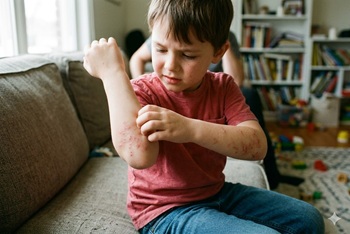
Scabies is one of the most common parasitic skin conditions seen in primary care and dermatology. Global estimates place the population burden in the hundreds of millions at any given time, and reported incidence has been rising in several high-income settings. Infestation is caused by the mite Sarcoptes scabiei var. hominis. Transmission occurs mainly through prolonged direct skin-to-skin contact; spread via fomites (clothing, bedding) is possible but less common than person-to-person contact. Household members and sexual partners are at high risk because asymptomatic carriers can transmit mites for weeks before typical pruritus and burrows appear. That pattern makes simultaneous treatment of close contacts central to successful management.
To compare two standard therapies head-to-head at the household level, investigators conducted the SCRATCH (Scabies Randomized Trial in Children and Adults), a multicentre, assessor-blinded, cluster-randomized trial in France. Index cases were children or adults with classic scabies confirmed by dermoscopy; each index case and household members represented a cluster, and they received the same assigned regimen (except children weighing <15 kg, who received topical 5% permethrin per protocol). Clusters were randomized 1:1 to oral ivermectin 200 mcg/kg with food on days 0 and 10 or 5% permethrin cream applied head-to-toe on days 0 and 10 (cream left on overnight). The primary outcome was cluster-level clinical cure on day 28, defined as all cluster members being free of scabies signs and symptoms. The main analysis included 507 participants in 142 ivermectin clusters and 568 participants in 147 permethrin clusters. Cluster cure rates were 71.8% with ivermectin versus 88.5% with permethrin (difference −16.7 percentage points; 95% CI −26.3 to −7.1). A secondary analysis evaluating outcomes at the individual level also favoured permethrin (94.2% versus 85.3%).
This study supports recommendations to use permethrin as first-line treatment for scabies when the skin can tolerate full-body topical application and adherence is feasible. Ivermectin may be appropriate as a second-line treatment when permethrin is impractical (e.g., institutional outbreaks, severe barriers to bathing or cream application, or settings where coordinated whole-body topical therapy cannot be achieved). Resistance and local epidemiology may alter choices in some regions.
