

TRIAL FINDS INCREASED FLUID INTAKE DOES NOT HELP PREVENT RECURRENT KIDNEY STONES
Results were likely biased by the Hawthorne effect
Straight Healthcare
April 2026
April 2026

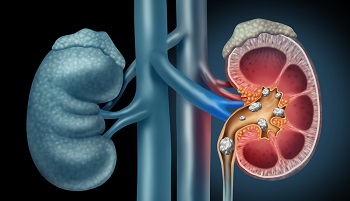
Clinical guidelines universally recommend increased fluid intake as a primary strategy to prevent recurrent kidney stones. By decreasing the concentrations of lithogenic salts, such as calcium, oxalate, and uric acid, higher urine volumes reduce the likelihood of stone formation. Most major medical societies recommend a goal of at least 2.5 liters of urine output per day for individuals with a history of nephrolithiasis. However, achieving and sustaining this level of hydration in daily life is difficult for many patients.
To investigate the effects of increased fluid intake on stone recurrence, researchers performed the PUSH trial, where 1,658 participants (826 intervention; 832 control) aged 12 years and older with a history of urinary stones and low baseline 24-hour urine volumes (<2.0 L/day) were randomized to increased fluid intake or standard care. The intervention group received a personalized "fluid prescription" with a goal urine output of more than 2.5 L/day, health coaching, and a Bluetooth-enabled "smart" water bottle to track intake in real time. They were also offered loss-framed financial incentives of $1.50 per day for meeting their intake goals during the first six months. The control group received usual care and a smart bottle for data collection, but its use was not incentivized or coached. Fluid intake was measured via both the Bluetooth bottle and periodic 24-hour urine collections. At 6 months, the intervention group had increased their urine output by 600 ml, while the usual care group had increased theirs by 360 ml, yielding a difference of 150 ml. Over the next 18 months, the difference ranged from 80 to 110 ml. After two years, there was no significant difference in the primary endpoint of symptomatic stone recurrence, which occurred in 18.6% of the intervention group and 19.8% of the control group (Hazard Ratio [HR]: 0.96; 95% CI, 0.77 to 1.20).
The authors concluded that the intervention was unsuccessful in reducing clinical events because the treatment effect was too modest. Although the intervention group achieved higher 24-hour urine volumes, the control group also increased their fluid intake significantly, resulting in a small net difference between groups. This effect likely occurred because control subjects were managed at specialty centers and felt monitored by the smart bottle, improving their adherence to standard guidelines beyond typical levels. This is referred to as the Hawthorne effect, a phenomenon where subjects in a trial behave differently because they know they are being observed. Lastly, the study showed that achieving a urinary output of more than 2.5 L/day may be unrealistic for most people. The highest average output achieved by the intervention group was 1.81 L/day at 6 months. From there, output decreased to an average of 1.55 L/day at 2 years, with the intervention group reporting a higher incidence of urinary frequency and urgency.
To investigate the effects of increased fluid intake on stone recurrence, researchers performed the PUSH trial, where 1,658 participants (826 intervention; 832 control) aged 12 years and older with a history of urinary stones and low baseline 24-hour urine volumes (<2.0 L/day) were randomized to increased fluid intake or standard care. The intervention group received a personalized "fluid prescription" with a goal urine output of more than 2.5 L/day, health coaching, and a Bluetooth-enabled "smart" water bottle to track intake in real time. They were also offered loss-framed financial incentives of $1.50 per day for meeting their intake goals during the first six months. The control group received usual care and a smart bottle for data collection, but its use was not incentivized or coached. Fluid intake was measured via both the Bluetooth bottle and periodic 24-hour urine collections. At 6 months, the intervention group had increased their urine output by 600 ml, while the usual care group had increased theirs by 360 ml, yielding a difference of 150 ml. Over the next 18 months, the difference ranged from 80 to 110 ml. After two years, there was no significant difference in the primary endpoint of symptomatic stone recurrence, which occurred in 18.6% of the intervention group and 19.8% of the control group (Hazard Ratio [HR]: 0.96; 95% CI, 0.77 to 1.20).
The authors concluded that the intervention was unsuccessful in reducing clinical events because the treatment effect was too modest. Although the intervention group achieved higher 24-hour urine volumes, the control group also increased their fluid intake significantly, resulting in a small net difference between groups. This effect likely occurred because control subjects were managed at specialty centers and felt monitored by the smart bottle, improving their adherence to standard guidelines beyond typical levels. This is referred to as the Hawthorne effect, a phenomenon where subjects in a trial behave differently because they know they are being observed. Lastly, the study showed that achieving a urinary output of more than 2.5 L/day may be unrealistic for most people. The highest average output achieved by the intervention group was 1.81 L/day at 6 months. From there, output decreased to an average of 1.55 L/day at 2 years, with the intervention group reporting a higher incidence of urinary frequency and urgency.
- Prevention of urinary stones with hydration: a randomised clinical trial of an adherence intervention, Lancet (2026) [PubMed abstract]
- Hawthorne effect
